What Makes a Great Zeus or Game Master? How to Run Milsim Operations Your Unit Will Talk About All Week
Any mission maker can spawn 200 AI and four BTRs on an objective. The real art of running a milsim operation is pacing the fight, giving every element a task, and knowing when to adapt on the fly.
Oct 24, 2026
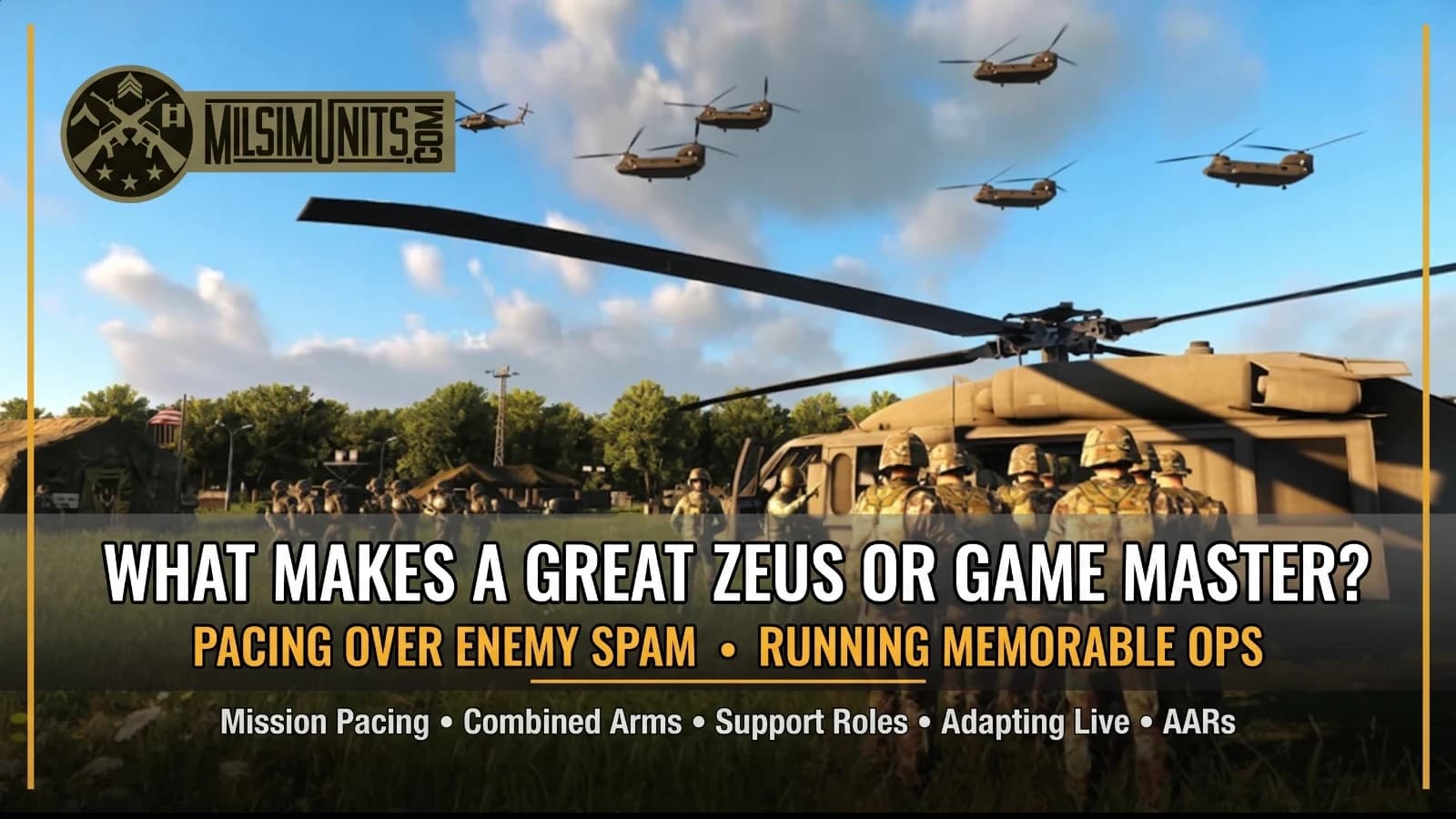
Ask any veteran player why they stayed in their unit for three or four years, and they'll usually tell you a story about a specific Sunday operation where everything went sideways, the squad barely made it to the LZ with two magazines left, and aviation pulled off a last-second dustoff under heavy fire.
Behind every moment like that is a mission maker, Zeus, or Game Master who knows what they're doing.
On the flip side, we've all sat through operations that felt like a two hour walking simulator followed by getting wiped out in ten seconds by an aimbot machine gunner hidden in a bush. Whether your unit runs operations in Arma Reforger and Arma 3 or any games that features mission making, building a mission that challenges dozens or even hundreds of players without frustrating them is one of the hardest jobs in milsim.
BUT FIRST: Looking for a unit with dedicated mission makers and structured weekend campaigns, or trying to recruit an experienced Zeus for your own S-2 shop? Browse active communities on MilSim Units, and make sure your server hardware isn't bottlenecking your AI scripts by checking the MilSim Units Server Providers Directory.
1. Pacing Beats Enemy Spam Every Single Time
The biggest mistake new mission makers make is thinking that "more enemies = harder mission." When a squad is doing well and pushing through a town cleanly, a rookie Zeus often panics and drops three more enemy squads and an armored vehicle right on top of them.
All that does is tank server FPS, burn through your medics' supplies in five minutes, and turn a tactical operation into a meat grinder. Great operations are built around pacing, just like a good movie:
-
The Infil & Recon Phase: Give squads 10 to 15 minutes to dismount, set up their radio nets, and let their pointmen or recon elements actually spot enemy patrols before the shooting starts.
-
The Initial Contact: Start with realistic outer security (a two-man OP or a light patrol) that reacts, pops smoke, and falls back toward the main compound instead of fighting to the death in an open field.
-
The Climax & Counterattack: Let the platoon secure the objective, consolidate casualties, and start setting up 360-degree security, and then hit them with a planned QRF from a logical direction so they have to defend what they just took.
2. Give Every Element a Real Job (Especially Support & Medics)
Nothing kills morale faster than signing up as a Helicopter Pilot or Mortar Crewman and spending 90 minutes staring at the map at base because the mission maker forgot to build tasks for anyone outside the rifle squads.
When planning an operation, make sure every element on the roster has tasks to do:
-
Aviation & Logistics: Give pilots contested LZs, weather or AA threats that force terrain masking, and mid-mission ammo/medical resupply runs that the infantry actually needs to keep pushing.
-
Combat Medics & CLS: Balance incoming fire so soldiers take survivable wounds that require real triage and CASEVAC coordination rather than instant headshots from heavy calibers.
-
Weapons & Engineers: Place enemy bunkers, roadblocks, or minefields that require engineers to breach or mortar teams to suppress before the rifle squads can cross the street.
3. Punish Sloppy Tactics, Not Bad Luck
A good Game Master watches how a squad is moving, not just where they are on the map. If a fireteam uses smoke, sets up a base of fire with their autorifleman, and bounds across cover properly, reward them by letting the enemy get suppressed or retreat to the next building.
If a squad gets lazy and sprints down the middle of a main road in a tight clump without checking corners, that's the time to let an enemy PKM or ambush teach them a lesson (every FTL remembers the first time they walked their team into an ambush because they skipped overwatch). When players know their tactical choices actually change how the enemy reacts, they take every patrol seriously.
4. Keep Your After-Action Review (AAR / Debrief) Short and Honest
When the mission ends and everyone is back at base, nobody wants to sit through a 45 minute lecture at 10:30 PM on a Sunday night.
Keep your company or platoon AAR under 10 minutes. Have each Platoon Leadership call out their three "Sustains" (what worked well) and three "Improves" (what needs to get fixed in squad drills during the week) and give the mission makers honest feedback on server performance and pacing.
Who Is the Best Mission Maker in Your Unit?
What makes an operation unforgettable for your group, and what's your biggest pet peeve when a Zeus gets carried away? Drop a comment below and give a shoutout to your unit's mission maker teams.
Comments (1)
Sign in to join the discussion.
Over the years, I've had and seen a lot of great ones. I gotta say it comes down to how they interact in the role play situations, some take the "fun" to the next level!